-02.png)


What to Check Before a Water Test in South Florida
- Nina Meek
- Dec 30, 2025
- 7 min read

It’s 9:00 a.m., the sun is already cooking the dock, and you can hear lines squeak on cleats while boats idle out toward the inlet. A water test in South Florida moves fast, currents change, weather flips, and if you show up unprepared you can miss the one thing that would have saved you a big headache later.

Before a water test in South Florida, verify paperwork and insurance rules, check the marine forecast and tides, confirm required safety gear is onboard, then do a dockside systems check before leaving the slip. During the run, test steering, trim, bilge, electronics, and engine temps, then do a slow idle check and a brief higher-speed check once the engine is warmed up. Finish by re-checking for leaks and any alarms or warning lights.
What should you do before the water test even starts?

Lock in the boring stuff first, because that’s what keeps the test from turning into chaos.
Confirm who’s responsible if something breaks during the water test.
Confirm where you’re launching from, and whether the route includes an inlet run or stays Intracoastal.
Ask for a true cold start. If the engine is already warm when you arrive, you lose a ton of useful signals.
If you’re buying, plan a survey. A prepurchase survey is meant to be comprehensive and often includes operational testing plus a sea trial.
If you want the simplest rule, it’s this, don’t treat a water test like a fun ride. Treat it like an inspection you happen to be doing on the water. At Happy Jack's Marine we are happy to answer all your questions.
What weather and tide info should you check in South Florida first?

Check the marine forecast, then check the tides for the exact inlet or area you’ll run.
South Florida water tests get sketchy when you ignore tides and inlets. Tides and currents can make an inlet feel totally different within the same morning, and NOAA tide predictions make it easy to time a calmer window.
If your water test involves Hillsboro Inlet, it’s also worth knowing local current behavior. The Hillsboro Inlet District notes current at the bridge can run up to six knots, with ebb currents tending to push vessels toward the south reef and flood currents pushing the opposite direction.
My preference for a used-boat water test in South Florida, if you have any say, is simple: pick a window with cleaner conditions, then do the “stress tests” while you still have daylight and patience.
What safety equipment should be on board for the water test?

You need the legally required basics, plus a few items that make a test safer and smoother.
Florida’s boating regulations and equipment pages lay out size-based requirements like PFDs, visual distress signals, sound-producing devices, and lighting.
For federal requirements and details like visual distress signals, the Coast Guard’s boater guide is a solid reference.
Two specifics people miss a lot:
Visual distress signals can be required based on vessel length and where you operate. Florida’s regs spell this out clearly for coastal waters.
Fire extinguisher rules changed for newer model years. The Coast Guard has a clear FAQ on what’s required for model year 2018 and newer, including the 5-B or 20-B ratings and date-stamp expectations.
If you want a clean, no-drama move, do a quick gear check before lines come off. It keeps the “we can’t leave the dock” moment from happening
What should you check at the dock before you leave?

This is where you catch easy wins.
Dockside checklist (fast but real)
Bilge and under-deck: open hatches, look for water, sniff for fuel smell.
Batteries and switches: confirm everything powers on, no weak crank.
Navigation lights and horn: lighting matters at night and in reduced visibility, and Florida references the Navigation Rules for requirements.
Electronics: GPS/MFD boots, depth reads, VHF powers on.
Livewell and freshwater systems: run pumps for a minute.
Steering feel: turn lock-to-lock at the dock, feel for binding.
Trim tabs and engine trim: cycle them, listen for odd grinding.
A small imperfection that matters a lot, pumps that “kind of” work at the dock often fail once you’re moving and the boat starts pulling air. If a livewell pump loses prime or the bilge sounds weak, note it and retest.
Text-a-friend line, if you want it: if the seller won’t open hatches or let you see the bilge, I’m not leaving the slip.
What should you test during the water test run?

You want to test handling, systems under load, and performance in a way that matches how you’ll actually use the boat.
Discover Boating’s sea trial guidance hits a few smart moves, like checking tracking at no-wake speed, running at higher speed, and doing a hard turn around 30 mph to see how the boat behaves.
On-water checks that matter most
Idle and no-wake behavior: Does it track straight or wander? Any vibration?
Steering under load: Smooth turn both directions, no clunks, no “sticky” spots.
Engine temps and alarms: Watch gauges, listen for alarms, look for warning lights.
Trim response: Does trim change attitude cleanly, or does it porpoise hard?
Planing and acceleration: Does it get on plane without drama?
Bilge underway: Check the bilge again after 10 to 15 minutes running.
Electronics while moving: Depth and GPS can act fine at the dock and fail at speed if wiring is sketchy.
Ride quality: Rattles, pounding, and spray pattern tell you a lot about hull attitude.
South Florida detail: if you’re going to run an inlet, pick the moment carefully. A strong outgoing tide with wind against it can stack up steep, short-period chop and make the boat feel worse than it really is. Use tides and the marine forecast to choose the right window.
How do you know if the boat is running “right”?

You’re looking for clean patterns, not perfection.
Quick read signals to watch
Smooth throttle response, no hesitation
Stable temps and water pressure behavior, no repeated alarms
No fuel smell, no new water in the bilge after running
Steering that stays consistent under speed
Electronics that stay on and don’t reboot when you hit wakes
If you want a more structured way to judge what you’re seeing, BoatUS has a boat evaluation checklist mindset that’s useful for scoring condition instead of going off vibes.
What are the most common water test mistakes in South Florida?

This is where people get cooked.
Skipping the cold start A warm engine hides issues like weak starting, rough idle, smoke, and battery problems.
Only riding Intracoastal at idle You learn almost nothing if you never run the boat the way you’ll actually use it.
Not checking tides and inlet timing A bad tide window can turn a normal water test into a white-knuckle ride. NOAA tide predictions exist for a reason.
Not checking the bilge twice Check it at the dock, then again after you’ve been running.
Ignoring safety equipment until “later” Florida and federal requirements aren’t optional, and during a water test you want the basics onboard from the start.
What to check before a water test in South Florida before you leave the dock step by step
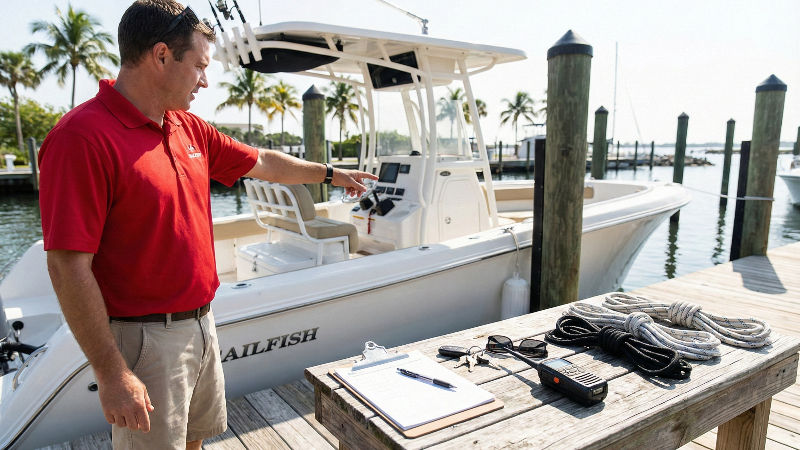
Here’s a simple method that stays practical.
Step 1: Before you leave the dock (10 minutes)
Do the dockside checklist, open hatches, test pumps, confirm electronics.
Step 2: Idle and no-wake (5 to 10 minutes)
Track straight, check steering feel, listen for vibration.
Step 3: Get on plane and run mid-range (10 to 15 minutes)
Watch temps, check trim, confirm ride stability.
Step 4: Higher-speed check, then controlled turns (5 to 10 minutes)
Once warmed up, do a brief higher-speed run, then controlled turns similar to the Discover Boating checklist approach.
Step 5: Back down to idle, then re-check bilge (5 minutes)
Look for fresh water intrusion, new smells, any alarms.
Mini checklist you can screenshot

Cold start confirmed
Marine forecast checked
Tide window checked for your inlet
Safety gear onboard
Bilge checked at dock
Pumps tested
Electronics tested at speed
Steering tested both directions under load
Temps watched, no alarms
Bilge checked again after running
Simple table, “If you see this, do that”

What you notice | What it can mean | What to do next |
Strong fuel smell | Ventilation or fuel system issue | Stop test, inspect, don’t ignore it |
Bilge gaining water after running | Leak at thru-hull, plumbing, or fittings | Pause and locate source before continuing |
Electronics reboot at speed | Loose power, weak battery, bad wiring | Check battery health and connections |
Pulling hard to one side | Trim tab issue, steering, prop, hull loading | Retest with tabs neutral, inspect steering |
Overheating alarm | Cooling flow issue or sensor issue | Stop and verify cooling stream and temps |
FAQ
How long should a water test be on a used boat?
Aim for 45 to 90 minutes if possible. You want time for a cold start, idle, planing, mid-range run, a brief higher-speed check, and then a post-run bilge check.
Do I need a survey for a water test in South Florida?
If you’re buying, a survey is one of the smartest ways to avoid surprises. ABYC describes a prepurchase survey as comprehensive and it often includes operational testing plus a sea trial.
Should the water test include an inlet run?
If you plan to use the boat offshore, yes, an inlet run is meaningful. Time it around tides and forecast so you’re testing the boat, not gambling with conditions. NOAA tide predictions and the marine forecast are your friends.
What should I check first if the engine overheats during the water test?
Stop the test. Confirm the cooling stream, watch temps, and don’t keep pushing it. Overheating can turn a small issue into a big one fast.
What if the seller refuses a cold start?
Treat that as a yellow flag. A cold start shows you more than people think, and it’s a normal request for a buyer.
Can I do the water test only in the Intracoastal?
You can, but it’s incomplete if you plan to run offshore. At minimum, you still want planing, turns under load, and a real systems check underway.
What safety gear should always be onboard for the water test?
At minimum, meet Florida and federal requirements based on your vessel and where you’re operating. Florida regulations and the Coast Guard guide cover the details.
What’s the easiest way to compare two boats during water tests?
Use the same route and the same checklist for both. BoatUS-style scoring helps you stay consistent instead of getting distracted by cosmetics.

Amazon Shopping List, Water Test Day Essentials
You don’t need everything. These are the items people end up buying anyway, especially in Florida:
Offshore safety kit (flares, whistle, signals)
Life jackets
VHF radio
Floating waterproof dry bag
Dock lines and Fenders
Marine first aid kit
Towels and Hats
Non-slip deck shoes
Fish cleaning gloves and Fish cleaning tools
Cooler or insulated fish bag
Battery jump pack
Waterproof phone case
A good water test in South Florida is not about pushing the boat to impress yourself, it’s about confirming the systems behave the same way every time, under real load, in real conditions. If you want help planning a clean water test route, or you want a second set of eyes on what you’re seeing, drop a comment or reach out at www.HappyJacksMarine.com


Comments